
What Happens When Your TikTok Goes Viral: 30M Views Case Study
- Luciana Machado

- Apr 12
- 13 min read
Updated: Apr 16
The "Antarctica Ghost Ship" incident is a clear example of how fast false information spreads online once it gets going. In February 2026, I posted a 20-second video of a ship in Antarctica from my suite aboard the Seabourn Venture. It hit 30 million views in 30 days, spawned conspiracy theories, got flagged by TikTok, attracted predatory media licensing requests, and validated all I knew about the difference between virality and intentional reach.

1. THE NUMBERS, 30 MILLION VIEWS, 30 DAYS LATER
Let's start with the data, because that's what this is really about.
One video. No paid promotion, no strategy and no collaboration. A personal TikTok page I'd been casually posting to for a year and a half. I had just 193 followers (whom I didn't know), zero agenda.
Today, this is where we're at:
Full engagement breakdown as of March 28, 2026:
Views: 31 million
Likes: 3.9 million
Comments: 21,000
Shares: 109,000
Saves: 406,000
Followers: peaked at +14,000, settled at 10,500+
The overnight jump that changed everything: February 27 I had 310,000 views and thought I was handling it. February 28 I woke up to 5.6 million and understood I was not.

By the end of the month the video had been cited by Google AI, picked up without permission by a major media outlet, flagged by TikTok's own misinformation system — which then added a caption to my post in a voice that wasn't mine — and I had licensing requests sitting in my inbox from some of the biggest content aggregators on the internet. Every single contract was badly written. More on that shortly.
2. WHO I WAS BEFORE THE WAVE
Fifteen years in digital communications. Community management, brand strategy, content at scale — BBC, Microsoft Xbox, iTunes, the London 2012 Olympics. I've managed comment sections with hundreds of thousands of people moving through them in real time, handled brand crises, moderated viral moments, navigated misinformation threads professionally. I was trained by Scotland Yard and the Metropolitan Police in sensitive content moderation. I've cleared 1,000+ comment queues per hour live on BBC Radio 1's morning show.
I say this because it's the context that makes this story actually interesting. I was not a civilian when this happened, lol.
I knew the mechanics. And it still completely got away from me — which tells you something important about the difference between managing someone else's brand and suddenly becoming the subject of your own.
My TikTok was personal. Never promoted it, never had a content calendar, never wanted it to be a business.
I posted Antarctica content because I was there working — not on vacation, though that distinction would become its own problem — and because I know that what performs is content people haven't seen before. After a year and a half, I had 193 followers. I was genuinely fine with that.
I wanted one viral video. Just one. I thought that was a reasonable thing to want. Boy was I wrong.
3. THE VIDEO: EXACT BREAKDOWN

Drake Passage, Antarctica. From my window aboard the Seabourn Venture — one of the most technologically advanced expedition ships in the world, stabilizers, ice-class hull, the works, and we were still getting thrown around like laundry — I spotted a tall mast ship emerging through heavy fog on the horizon. The kind of ship that makes your brain go immediately to Pirates of the Caribbean. We were all saying it. Captain Jack Sparrow. Ghost ship energy. Obviously not an actual ghost ship — it was the Bark Europa, a famous Dutch tall sailing vessel, and I even tagged them in the caption.
Here is exactly what I posted:
On the video: "Spotted from my suite. Ghost ship in Antarctica."
Caption: "@Bark EUROPA [NOT AI. This is the real bark Europa, a historic, three-masted tall ship built in 1911, renowned as an "Ocean Wanderer"
Navio fantasma será??! Spotted as we sailed through Antarctica
#antartica #antarcticacruise #expedition #cruisetok #seabournventure como é um Cruzeiro para Antártida? fantástico. Que aventura
Now. The word "suite."
On the Seabourn Venture, every cabin is called a suite. That is exact terminology the ship uses, and it's not a flex, it's not a branding choice I made. It's what the room is called. But on TikTok, in 2026, "spotted from my suite" reads as someone rubbing a luxury holiday in the face of every person scrolling through their FYP (For You Page) at midnight. The perceived flex became the story before the ship even registered.

Language choice acted as a catalyst for what some have referred to social class based engagement. The hostility this word generated — and there was real hostility — ironically boosted the video's reach, because TikTok's algorithm interprets high comment volume, even negative comment volume, as valuable content worth pushing to more people. The algorithm doesn't distinguish between someone saying "this is beautiful" and someone saying "who does she think she is." Both count the same.
4. PHASE 1 | WHEN I THOUGHT I COULD MANAGE IT
The first comments weren't about the ship. They were about the suite.
I wasn't going to let that derail things. I know how comment sections work — you get in early, you correct the narrative, you keep it moving. So I started responding. Someone wrote that last time they checked, nobody could sleep in Antarctica. I genuinely loved that comment. I replied explaining that you absolutely can, on boats, and that there are dozens of active research bases on the continent. They came back: "oh okay, I didn't know that."
Progress.
Another person: "nobody lives there." Same move. Early crowd was curious, skeptical, engageable. My community manager brain was fully activated and I was handling it.
I leaned in. Posted five more videos: behind-the-scenes of the ship, the expedition, more Antarctica content. I was having fun with it. I thought: I've got this.
By the end of the day, on February 27, the video had hit 310,000 views. I went to sleep thinking I was on top of it.
Newsflash: I was not on top of it.
5. PHASE 2 | THE OVERNIGHT JUMP AND THE LOSS OF CONTROL
I woke up February 28 to 5.6 million views and a comment section I no longer recognized.
At that scale, what you have is not a conversation. It's a crowd.
And crowds don't read captions.
Here's what happened while I was asleep: someone spotted something in the reflection of my window. A yellow shape near the ship. They decided it was significant. It was the reflection of my bathroom door on the double-paned glass — ordinary, boring, completely explicable. But that detail had already been buried under thousands of comments by the time I saw it, and once something gets momentum in a TikTok thread, a correction is just another comment, it doesn't travel. The original claim always wins the race.
What people "saw" is a textbook case of visual pareidolia — the human tendency to find meaningful patterns in random objects. The reflections of my cabin's interior lights on the window became, depending on which thread you were in, glowing gateways to a land beyond the Antarctic ice wall. The yellow bathroom door became something "they" were hiding. By the end of the week, comments were connecting my footage to the Titanic being purposely sunk, claiming humans physically cannot live in Antarctica, and spinning conspiracy theories that had absolutely nothing to do with me or a Dutch sailing ship from the 1800s.

The comment section split. Half were people explaining it was the Bark Europa.
She literally tagged them in the caption, did you not read it?
The other half went somewhere else entirely and kept going.
The Bark Europa's official account came to my page to help. They replied to maybe 30 comments. Those replies were buried in seconds. Someone saw their responses and wrote:
oh the Bark Europa has already been here, you're late.
Which, yes, exactly. That is the problem.

I tagged Bark Europa in the caption. I explained what the ship was. My own replies with explanations were getting buried. Their replies were getting buried. TikTok does not allow creators to pin a comment to the top of their own post, which means there is no mechanism to keep a correction visible in a fast-moving thread. The misinformation had structural advantages that the truth simply did not have.
At that point I understood something I hadn't fully internalized before, even with 15 years in this industry: past a certain velocity, you are no longer the author of your own content. The video existed independently of me. Other people were telling its story now. I was just the person who had filmed it.

6. TIKTOK INTERVENED. MADE IT WORSE
Around day five or six, TikTok's misinformation system flagged the video and added a caption. Not a label, not a small notice — two full paragraphs, appended to my post, explaining that the ship was the Bark Europa, that it was not a ghost ship, and that the content was not AI-generated.
I could not edit it. I could not remove it. It was on my account, under my video, written in a voice that was not mine.
it read like a Bark Europa press release, and the audience noticed immediately — not in the way TikTok intended. The response was: "see, she's using AI to write her captions now." A platform intervention designed to fight misinformation became, in the comment section, evidence of more misinformation. I had zero recourse.
This is what automated moderation looks like at scale: it addresses the content, not the conversation. By day five the conversation had moved so far from the original content that a caption correction was completely irrelevant to anyone already deep in the thread. The algorithm intervened at the content layer when the problem was entirely at the social layer, and it made things worse in a way the system had no mechanism to detect.
Nobody was reading captions. That ship had sailed. Pun absolutely intended.
7. THE MEDIA REQUESTS | WHAT I FOUND WHEN I READ THE CONTRACTS
While the comment section was doing whatever it was doing, my inbox was filling up with licensing requests.
Newsweek. Unilad. LADbible. Barstool Sports. Pubity. Betches. A parade of content aggregators and meme factories, all waving the same email: we'd love to feature your content, just sign this release form.
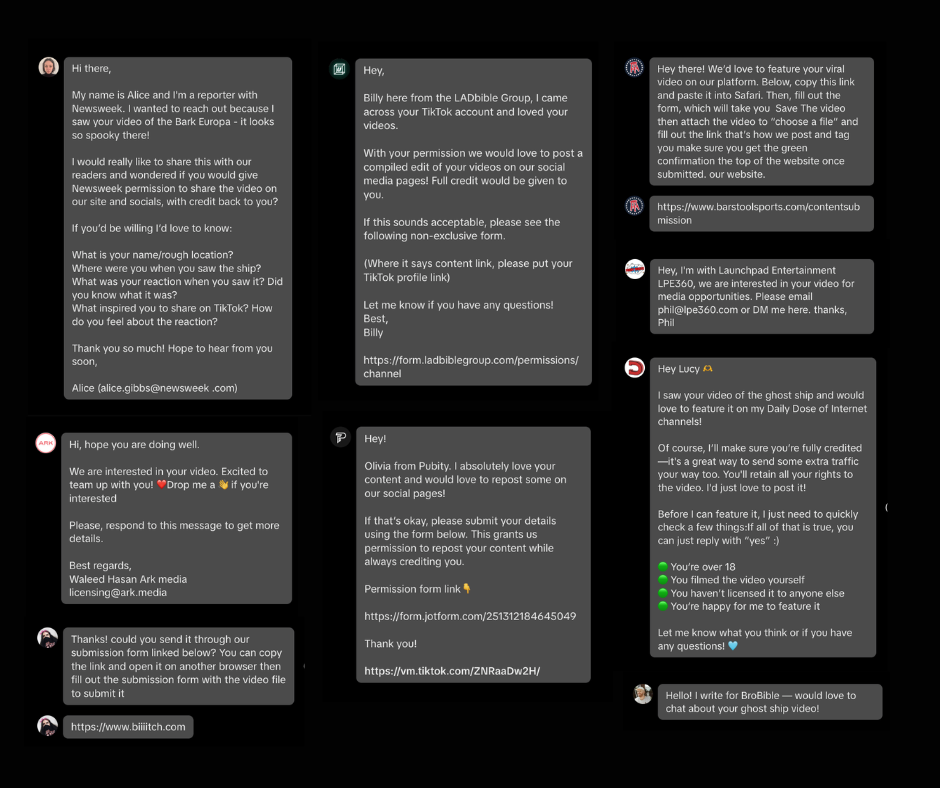
I read every single contract. All of them. Line by line.
Most people don't do this. Most people see a name they recognize, feel flattered, and sign. That is precisely what these companies are counting on. The entire model depends on processing creator content faster than anyone stops to scrutinize it. Speed is the mechanism. Slow it down and the deal falls apart.
Here is what I found:
Typos: Multiple, in legal documents from companies with full legal teams.
Missing sections: Sentences that stopped mid-clause, clearly copy-pasted from a template and never finished.
Contradictory clauses: For example, one paragraph granted rights that another paragraph said they didn't have, because the document had been redrafted so many times it had started arguing with itself.
And buried in all of it: the real terms.
When you sign these agreements, you are waiving what's legally known as your droit moral — your moral rights. In plain terms: you are giving up the legal ability to protect your own work and your own reputation. Here is what that actually means:
You can no longer object to how they edit you. The contracts grant what they call "absolute editorial and creative discretion" — they can cut, rearrange, reframe, and narrate your footage however they want. If they edit it in a way that embarrasses you, misrepresents you, or contradicts everything you stand for, you have no legal ground to stop them or seek damages.
They can tell a completely different story using your face. Your name becomes optional — or worse. They can use your likeness without crediting you at all. Or they can attach your name to a story you never told and would never endorse. Both options are in the contract.
You waive future defamation claims before they even happen. Several of the contracts I received explicitly made me waive claims for defamation, false light, and invasion of privacy caused by what the outlet does with my content. So if they narrate my footage to imply I said something I didn't, or suggest I was involved in something scandalous, I had already signed away my right to do anything about it.
The damage is permanent. These waivers are "in perpetuity" and "worldwide." Any reputational harm doesn't expire. I cannot take rights back if I become more well known, or if the outlet itself becomes a liability. They own the right to use my likeness and my content forever, across any platform "now known or hereinafter devised."
I said no to all of them.
Bro Bible published a story anyway. Wrong narrative, my face, no permission, no licensing agreement. Which was exactly why I hadn't signed in the first place. Basically, I could see what the story was going to become and I didn't want my name on it. They went ahead regardless.

Disappointment Galore
This is the media supply chain in 2026: a creator posts something, it goes viral, a swarm of content mills descends to extract value. The creator gets a few hundred dollars maybe, signs away control of their image, and the outlet gets traffic, ad revenue, and legal cover to do whatever they want with the footage. Forever. The contracts aren't sloppy because these companies are careless. They're sloppy because the whole model depends on volume and speed. It's a no from me.
8. THE MEANING OF METRICS

Let me break down the numbers properly, because 30 million views is the least interesting part of this.
30 million views. The headline number. On TikTok, a view counts at one second of watch time. It tells you the algorithm pushed the video hard. It tells you almost nothing about who watched, what they understood, or what they did next.
3.9 million likes. More meaningful as this requires an action. But on a video that went conspiratorial, likes were coming from people who thought they were engaging with a ghost ship clip. The intent behind the like is completely mixed.
21,000 comments. This is where the real story is. A comment requires the most effort of any TikTok engagement action. 21,000 people had something to say — and based on what I was watching in real time, a significant chunk of those were people deep in the Bark Europa debate, the yellow cube theory, the flat earth thread, or arguing with each other about whether I was flexing. High comment count does not mean good conversation.
109,000 shares. This is the number that explains how it spread so fast. Shares take the content outside its original context entirely — into group chats, onto other platforms, into conversations where my caption, my tags, and any correction I'd made were completely invisible. Every share was a fresh distribution of the story without the story's context.
406,000 saves. This is the number I keep coming back to. Saves are the most intentional action on TikTok — someone saving a video means they want to return to it. They found it genuinely interesting or useful enough to bookmark. 406,000 people saved a video of a ship in fog. Underneath all the conspiracy noise, the core content — Antarctica, the Drake Passage, the Bark Europa - resonated with a very large audience. That's real signal buried under a lot of noise.
Followers: peaked at 14,000, settled at 10,500+. The conversion rate from 30 million views to roughly 10,500 followers is approximately 0.035%. That ratio tells you exactly what kind of audience this video attracted. They came for the ghost ship. Most of them were not interested in me, Antarctica, or anything I was going to post next. A crowd is not an audience.
Google AI citation. The video is now part of the reference data that surfaces when people search for related content. The content has a longevity that extends well beyond the TikTok cycle — and a reach I cannot fully track or control.
9. LUCY LEARNS
The algorithm is unpredictable. That's the uncomfortable truth at the center of all of this. You can do everything right — good content, accurate caption, relevant tags, proper attribution — and still have no control over what the platform does with it once it hits a certain velocity. The algorithm has its own agenda and it is not yours.
Here's what I actually concluded from 28 days of watching this unfold:
Caption language carries more weight than most people account for. One word, "suite", reframed the entire first wave of audience response. If I had written "cabin" or "window" the conversation starts somewhere completely different. Word choice is not a small detail. It's the first filter through which 30 million people interpreted everything else.
At a certain scale, corrections become invisible. This is the one I want people to really sit with. I was in the comments correcting misinformation in real time. The Bark Europa's own verified account was in the comments correcting misinformation. None of it mattered — not because people didn't want the truth, but because the comment section was moving faster than any correction could travel. The original claim always has the head start. The correction never catches the lie. That's the real structural problem, and no individual creator has a solution to it.
Platform interventions address content, not conversation. TikTok's automated footnote was factually correct and contextually useless. By the time it appeared, the conversation had moved so far from the original content that a caption note was irrelevant to everyone already deep in the thread. It also actively made things worse by giving the audience new material to misinterpret. Automated moderation is built for content at the point of posting. It has no mechanism for the social dynamics that develop around content once it scales.
The media licensing industry moves on volume, not accuracy. The contracts I received were not professional documents. They were high-volume templates designed to be processed quickly by people who are too flattered or too busy to read them. Read slowly. It costs them the cycle they're counting on. And understand what you're actually signing away — not just credit, not just a clip, but your moral rights. Your legal ability to protect your own image and your own reputation. Permanently. Worldwide.
Virality and intentional reach are completely different problems. I did not build an audience. I attracted a crowd. Those are not the same thing. A crowd comes for the event and disperses. An audience comes for you and stays. 30 million views and 10,500 followers is a pretty stark illustration of that gap. The video did not create a community — it created a moment. Useful as data. Not useful as a foundation.
15 years of managing other people's communities did not prepare me for managing my own. This is the headline conclusion. When you manage a brand's presence you have distance — you are the strategist, not the subject. That distance collapses completely when it's your face, your words, your account. I made reactive decisions I would never have recommended to a client. I was operating at a scale where my best professional instincts were simply not calibrated for the situation.
10. WHY I'M LEAVING THE VIDEO UP
I'm a digital marketer. These numbers are real and I need to see them. 30 million views, 406,000 saves, cited by Google AI — I am not deleting that data because the experience was uncomfortable. That would be the least strategic decision I've ever made.
But there's something else I've been sitting with since this happened, and I want to say it directly.
During peak virality, with 5 to 10 million views and an engaged audience, it was clear how easy it would have been to monetize the moment. The crowd was emotionally invested and ready for a next step, making them likely to convert for products, courses, or subscriptions.
I decided not to engage with an audience that didn't trust me, as they were confused and had misconceptions. Profiting from that felt exploitative. I stress the importance of building a purposeful audience that knows what they're joining, rather than just collecting a large, uninterested following. The video is still online for reflection on these differences.
Be careful what you wish for, Creators. Going viral at scale is mostly just losing control of your own story while watching the numbers go up.
I watched the numbers go up.

Comments